
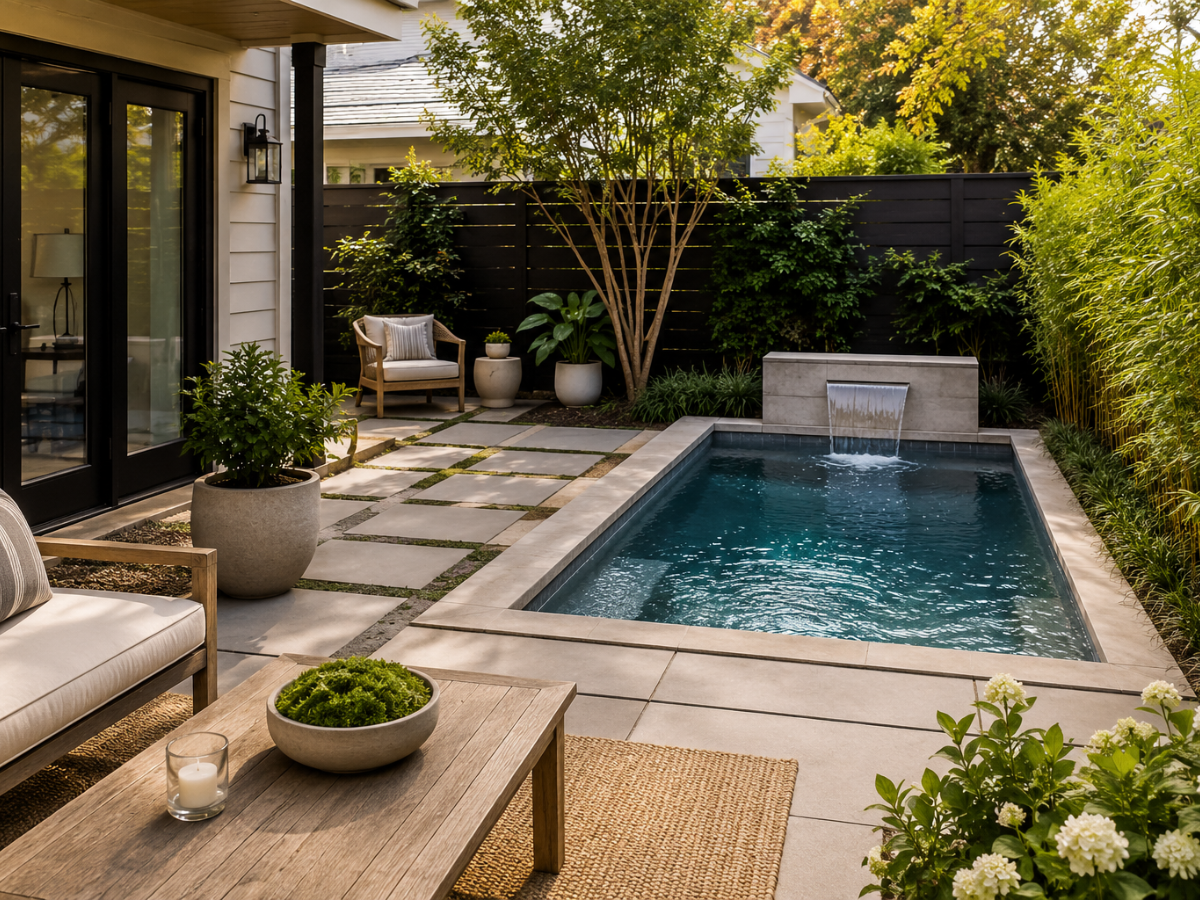
You don’t need a sprawling backyard to enjoy the luxury of a private pool. For Atlanta homeowners working with compact lots, plunge pools offer a space-conscious way to cool off, unwind, and create an inviting outdoor retreat without sacrificing the entire yard.
Small backyard plunge pool ideas can range from sleek geometric designs and built-in seating to spa-inspired features, creative decking, and landscaping that makes limited square footage feel intentional rather than crowded.
Atlanta’s warm climate also makes these compact pools especially appealing for extending outdoor enjoyment through much of the year.
Whether you’re redesigning a tight urban backyard or simply want a smaller alternative to a traditional swimming pool, thoughtful planning can turn a plunge pool into a striking centerpiece that maximizes both space and enjoyment.
Plunge Pool Ideas That Make the Most of Limited Space
What Is a Plunge Pool, and Why Does It Work Well in a Small Backyard?
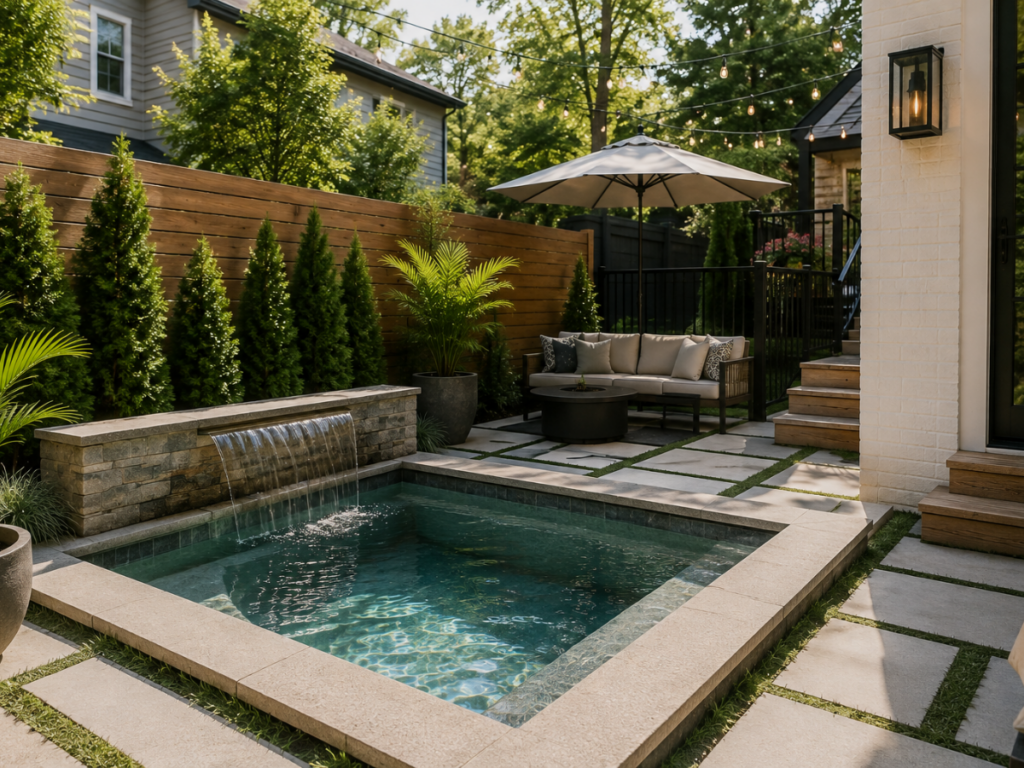
A plunge pool is a compact pool designed primarily for cooling off, relaxing, and enjoying the water rather than swimming long distances. Its smaller footprint makes it particularly appealing for homeowners who want a pool but do not want it to dominate the entire backyard.
That distinction matters. A small yard does not necessarily require homeowners to give up the idea of a pool. It requires a different approach to pool design.
The best plunge pool ideas treat the pool as one part of the outdoor living space, leaving room for patios, landscaping, seating, walkways, and other features that make the backyard useful.
Plunge Pools Make Better Use of Limited Backyard Space
Traditional swimming pools require considerable space not only for the pool itself, but also for the surrounding deck, equipment, access, and circulation areas. A plunge pool can work within a more compact footprint, giving designers greater flexibility when planning smaller properties.
Placement becomes especially important. Depending on the site, a plunge pool might be positioned along the edge of a patio, near an outdoor living area, or within an otherwise underused section of the yard.
The goal is not simply to fit the smallest possible pool into the available space. Good design considers how people will move around it and whether enough usable yard remains after installation.
A slightly smaller pool with comfortable surrounding space can be more functional than a larger pool squeezed tightly between property features.
A Smaller Pool Can Still Offer Plenty of Ways to Relax
Plunge pools are generally better suited to soaking, cooling off, and casual recreation than lap swimming. For many homeowners, however, those are the activities they actually want from a backyard pool.
Built-in benches or ledges can provide places to sit in the water. Depending on the pool design and equipment, homeowners may also consider features such as heating, spa jets, water features, or underwater lighting.
This flexibility makes plunge pools useful beyond the hottest part of summer. A heated design, for example, may provide a different experience from a pool intended primarily for cooling off.
Before selecting features, think about how the pool will realistically be used. A household interested primarily in quiet relaxation may make very different choices from one designing a backyard for entertaining friends and family.
Plunge Pools Leave More Room for Outdoor Living
One of the strongest reasons to consider a plunge pool is what can happen around it.
Instead of allowing the pool to consume most of the backyard, a compact design can preserve space for dining, grilling, lounge chairs, gardens, fire features, or a covered patio. This can be particularly valuable on smaller Atlanta properties where every section of the yard needs to serve a purpose.
Some of the most effective plunge pool ideas visually connect the water with the rest of the landscape. Matching or complementary materials around the pool and patio can make separate areas feel intentional rather than pieced together.
Plantings can soften hard surfaces, while carefully positioned seating can turn the pool into a focal point even when nobody is swimming.
The Design Can Be Customized to the Property
“Small” does not have to mean basic. The shape, depth, finish, surrounding materials, entry style, and water features can all influence how a plunge pool looks and functions.
For a narrow backyard, a rectangular pool may use the available space efficiently. In another setting, a square, geometric, or custom shape may fit more naturally around existing patios or landscaping.
Design details can also make the space feel larger. Clean lines, consistent paving, uncluttered landscaping, and a strong visual connection between the pool and patio can create a more cohesive outdoor environment.
Plunge Pools May Require Less Water, but They Still Need Pool Equipment
Because plunge pools contain less water than larger pools, they can reduce the amount of water that must be filled, filtered, treated, and potentially heated. The actual operating requirements, however, depend on pool size, equipment, usage, features, and local conditions.
A plunge pool still requires proper circulation, filtration, sanitation, drainage planning, and routine maintenance. Heating, lighting, jets, and other optional features can also affect energy use and ongoing costs.
For that reason, homeowners comparing plunge pool ideas should look beyond dimensions alone. The better question is how the entire pool will function once it becomes part of everyday life.
A Plunge Pool Can Solve More Than a Space Problem
The appeal of a plunge pool is not simply that it is a smaller version of a traditional swimming pool. A well-planned design can create a different type of backyard altogether.
For homeowners who care more about cooling off, relaxing, entertaining, and improving their outdoor living space than swimming laps, a compact pool may provide the functionality they want without overwhelming the yard.
The key is designing the pool around the property and the way the household plans to use it, rather than choosing a size first and trying to make everything else fit around it.
How to Design a Custom Compact Plunge Pool in Atlanta
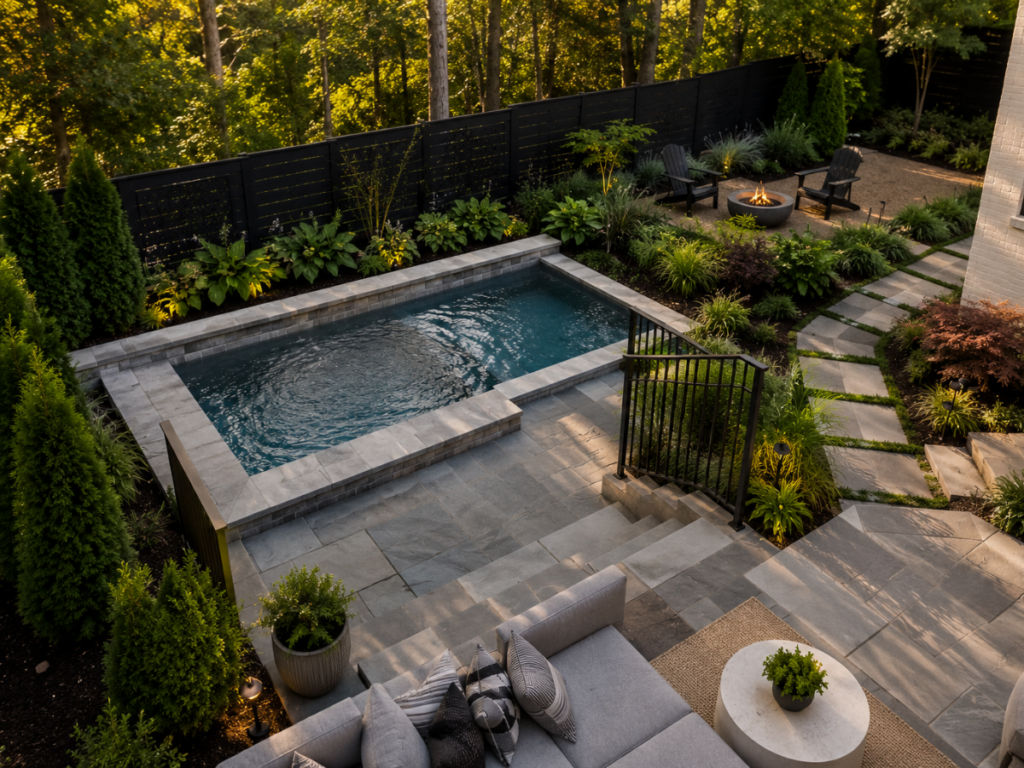
A successful plunge pool design starts with the backyard, not with a catalog of pool shapes. On a compact property, every foot matters. The pool has to work alongside patios, walkways, landscaping, drainage, equipment, and the areas you still want available for everyday outdoor living.
For Atlanta homeowners exploring plunge pool ideas, the design process should also account for the property’s slope, sun exposure, existing landscape, access for construction, and how the pool will actually be used.
Making those decisions early can produce a space that feels intentional rather than a full-size pool concept squeezed into a smaller yard.
Start With How You Want to Use the Pool
Before settling on dimensions or finishes, decide what you want the pool to do.
A pool intended mainly for cooling off and lounging may benefit from generous built-in seating. If you expect children or several family members to use it regularly, usable interior space and entry points may matter more. Homeowners interested in a spa-like experience might prioritize heating, jets, or submerged benches.
Think about the surrounding space as well. If entertaining is important, preserving enough room for seating and dining could be more valuable than increasing the pool by a few feet.
This is where compact design becomes an advantage. Instead of asking, “How large a pool can we fit?” ask, “How should the entire backyard work once the pool is here?”
Choose a Pool Shape That Works With the Yard
The best shape is often determined by the property rather than design trends.
Rectangular plunge pools work particularly well with contemporary homes, narrow lots, and structured patios. Their straight edges can make it easier to organize decking, furniture, and landscaping around the pool.
Square or compact geometric pools can fit naturally into courtyards or corners where a longer pool would interfere with circulation.
Free-form pools create softer lines and can integrate well with informal landscaping. They may be useful when the goal is to make the pool feel like part of a garden rather than a separate architectural feature.
A designer may also recommend a custom configuration when property lines, existing patios, mature trees, slopes, or other site conditions make a standard shape impractical.
Compare Fiberglass, Concrete, and Vinyl Pool Construction
Construction material affects much more than appearance. It can influence design flexibility, installation, maintenance, and which dimensions are available.
| Pool Type | Best Suited For | Design Considerations |
|---|---|---|
| Fiberglass | Homeowners wanting a premanufactured shell | Available sizes and shapes are determined by the manufacturer |
| Concrete | Highly customized layouts | Can accommodate unusual dimensions, depths, benches, and finishes |
| Vinyl liner | Customizable shapes with a smooth interior surface | Liner condition and eventual replacement should be factored into long-term planning |
There is no single material that is best for every plunge pool. Site access can also influence the decision. For example, installing a premanufactured fiberglass shell requires sufficient access to move the pool into position, while concrete construction follows a different installation process.
Make Built-In Features Earn Their Space
In a compact pool, features should ideally serve more than one purpose.
A wide entry step can double as a sitting area. A submerged bench can create a comfortable place to relax without requiring additional poolside furniture. A raised pool edge may become informal seating when designed appropriately.
Other plunge pool ideas include tanning ledges, spa jets, water features, underwater lighting, heating, and integrated steps. Rather than adding features simply because they are available, consider how much interior space each one occupies and how frequently you will use it.
A large tanning ledge, for example, may be attractive but could consume a substantial portion of a very small pool.
Design the Pool and Patio as One Space
The area immediately surrounding the pool has a major influence on whether a compact backyard feels spacious or crowded.
Keeping materials visually consistent can help the pool, patio, and outdoor living areas feel connected. Decking or paving should also be selected with outdoor durability, drainage, maintenance, and slip resistance in mind.
Landscaping deserves the same attention. Plants can provide privacy and soften hard surfaces, but placement matters. Roots, falling leaves, and plants that grow aggressively near the pool can create maintenance problems later.
Plan for Atlanta Site Conditions Before Finalizing the Design
A design that looks perfect on paper still has to work on the actual property. Drainage, grading, underground utilities, equipment placement, construction access, and applicable setback or permitting requirements can all influence where and how a plunge pool can be built.
Sloped properties may require additional grading or retaining solutions, while limited side-yard access can affect construction methods.
For that reason, the strongest plunge pool ideas are developed after a site evaluation rather than chosen solely from inspiration photos.
Designing around the realities of the property makes it easier to create a compact pool that looks proportional, functions comfortably, and feels like it has always belonged in the backyard.
What to Expect During a Plunge Pool Installation
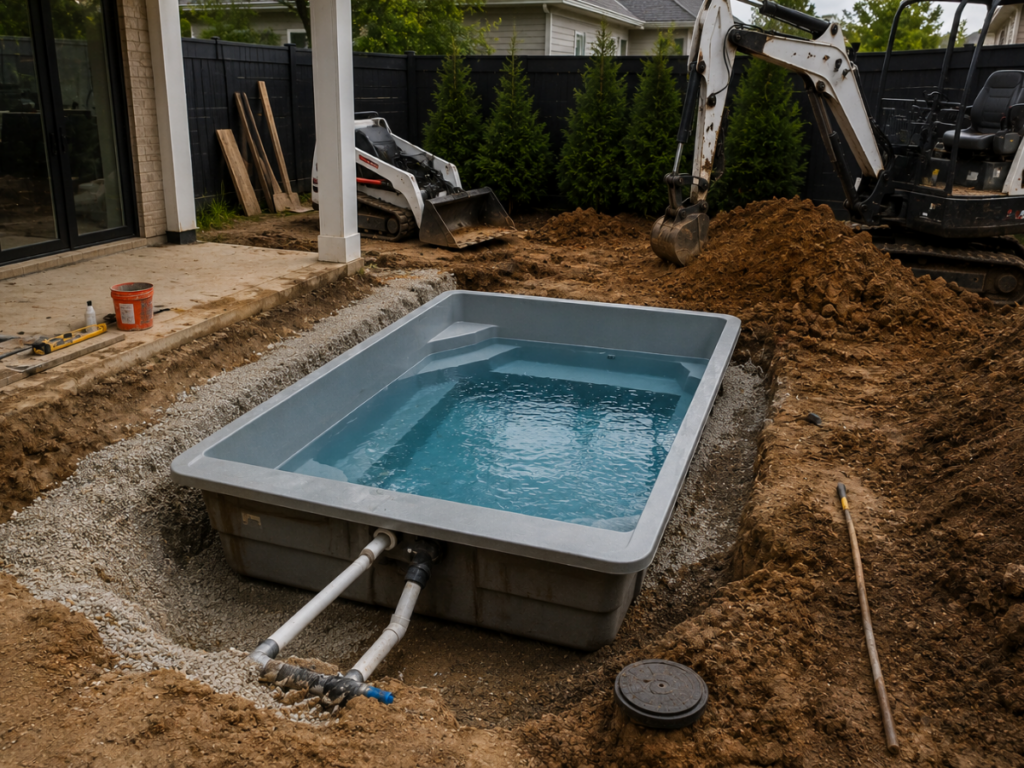
Once the design is finalized, a plunge pool project moves from planning into site preparation, construction, and finishing.
Although the pool itself is compact, installation still involves many of the same considerations as a larger in-ground pool, including excavation, plumbing, electrical work, drainage, structural preparation, and code compliance.
The exact process varies according to the pool type, property conditions, and design. A fiberglass shell, for example, follows a different construction sequence from a custom concrete pool. Understanding the major stages helps homeowners know what to expect and where delays or additional work can arise.
Start With a Detailed Site Evaluation
Before excavation begins, the builder needs to confirm that the proposed location actually works.
This involves evaluating property access, grading, drainage, soil conditions, underground utilities, and the space available for construction equipment. The location of the house, property lines, existing patios, retaining walls, trees, and other structures may also influence the final placement.
Access deserves particular attention in smaller Atlanta backyards. A compact pool may fit comfortably once installed, but equipment and materials still have to reach the construction area. Limited side-yard access or difficult terrain can affect both the installation method and project cost.
This stage is also when plans should be checked against applicable zoning, permitting, and safety requirements before construction proceeds.
Prepare and Excavate the Pool Area
After the layout has been approved and necessary pre-construction requirements are addressed, the pool location is marked, and excavation can begin.
The amount of excavation depends on the dimensions and depth of the pool as well as existing grade. Sloped yards or challenging soil conditions may require additional preparation, drainage work, or structural solutions.
Excavation also creates displaced soil that needs somewhere to go. Some may be useful for grading elsewhere on the property, while excess material may need to be hauled away. Planning for this beforehand can help prevent the construction site from becoming unnecessarily congested.
Install the Pool Structure and Essential Systems
What happens next depends heavily on the construction method.
A fiberglass plunge pool uses a premanufactured shell that is delivered and positioned in the prepared excavation. Concrete pools are constructed on-site, allowing greater freedom in dimensions, depth, benches, steps, and other custom details. Vinyl-liner pools have their own structural and installation requirements.
At this stage, contractors also coordinate the systems that make the pool function, which can include:
- Circulation and filtration equipment
- Pumps and plumbing lines
- Drains and returns
- Electrical connections
- Lighting
- Heating equipment
- Spa jets or water features, when included in the design
This is one reason some plunge pool ideas that appear simple visually can involve considerable planning behind the scenes. Equipment still needs appropriate placement, access for future servicing, and connections that meet applicable requirements.
Complete Coping, Decking, and Surrounding Features
Once the pool structure and major systems are in place, attention shifts to the surrounding environment.
Coping finishes the pool edge, while decking or paving creates the usable surface around it. Depending on the project, this stage might also include steps, retaining walls, drainage improvements, landscaping, outdoor lighting, or connections to an existing patio.
For compact properties, these details have an outsized effect on the finished result. Poorly proportioned decking can make a small yard feel crowded, while thoughtful material transitions can visually connect the pool to the house and surrounding landscape.
This is also the point where many plunge pool ideas begin to look like complete outdoor living spaces rather than isolated pools.
Plan for Permits, Barriers, and Code Compliance
Pool requirements can vary according to the property, project scope, and governing jurisdiction, so homeowners should confirm current requirements for their specific address rather than relying on a generic checklist.
Depending on the project, plans may need to address permits, zoning or setback rules, required barriers, gates, electrical work, plumbing, drainage, and inspections. Properties within the City of Atlanta and those elsewhere in the metro area may fall under different local authorities.
Safety barriers deserve particular attention. Pool access needs to be considered during the design stage so that fencing, gates, and other required safeguards can be incorporated without feeling like an afterthought.
How Long Does Plunge Pool Installation Take?
There is no reliable universal timeline for a plunge pool installation. The original estimate of six to twelve weeks is too specific without knowing the construction method, permitting process, site conditions, contractor schedule, and project scope.
A straightforward installation on an accessible property may progress much differently from a custom concrete project involving grading, retaining walls, extensive hardscaping, or difficult access. Weather and inspections can also affect the schedule.
Homeowners comparing plunge pool ideas should therefore ask prospective builders for a project-specific timeline that separates permitting and design from actual construction.
A clear schedule should identify the major phases, explain what could cause delays, and clarify when surrounding patios and landscaping will be completed.
The pool may be compact, but the quality of the installation still depends on careful planning.
Treating excavation, drainage, utilities, structural work, safety requirements, and the surrounding landscape as parts of one project creates a much stronger foundation for a plunge pool that works well long after construction is finished.
How to Maintain a Plunge Pool and Keep It Safe
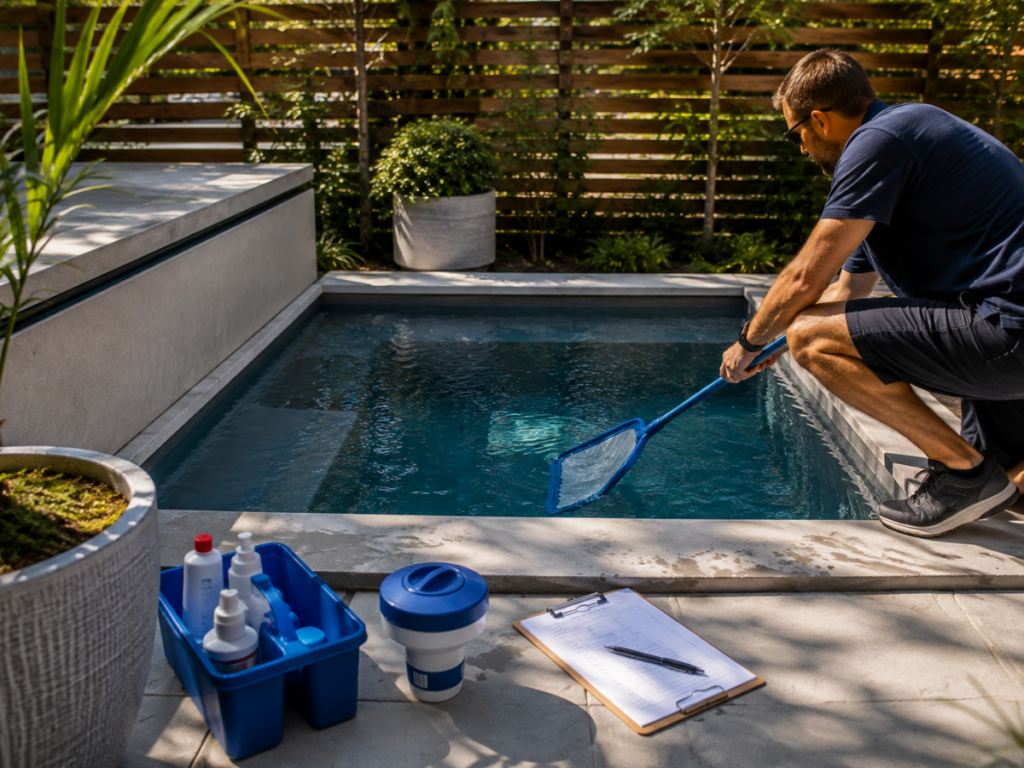
A smaller pool does not mean a maintenance-free pool. Plunge pools still rely on proper circulation, filtration, sanitation, and routine cleaning to keep the water clear and the equipment working properly.
Their compact size can make some tasks quicker, but it also means changes in water chemistry may become noticeable quickly because there is less water in the pool.
Maintenance should therefore be considered while comparing plunge pool ideas, not after construction is complete. Equipment placement, landscaping, covers, heating, and water features can all affect how much attention the pool requires over time.
Keep Water Chemistry Consistent
Regular water testing is one of the most important parts of plunge pool maintenance. Sanitizer levels, pH, and total alkalinity need to remain within the appropriate ranges for the pool and sanitation system being used.
Avoid relying on appearance alone. Clear water does not necessarily mean the chemistry is properly balanced.
How often testing and treatment are required depends on factors such as pool use, weather, water temperature, rainfall, and the type of sanitation equipment installed. After heavy use or significant weather events, checking the water can help identify changes before they become larger problems.
If you are unsure about chemical levels or treatment procedures, follow the pool equipment and chemical manufacturers’ instructions or have the water professionally tested.
Create a Simple Cleaning Routine
Leaves, pollen, insects, grass clippings, and other debris can still accumulate in a compact pool. In heavily landscaped Atlanta backyards, surrounding trees and plants may increase the amount of material reaching the water.
Routine maintenance may include:
- Skimming floating debris from the surface
- Brushing walls, steps, benches, and the waterline
- Vacuuming or using a compatible automatic pool cleaner
- Emptying skimmer and pump baskets as needed
- Checking filters and cleaning them according to manufacturer recommendations
Pay particular attention to built-in benches, steps, corners, and other areas where circulation may be weaker and debris can settle.
Landscaping choices can make this job easier. When evaluating plunge pool ideas, consider whether nearby plants shed heavily or produce seeds, flowers, and leaves that are likely to end up in the water.
Check the Pump, Filter, and Water Level
The circulation system is central to maintaining water quality. Periodically inspect the pump and filtration equipment for unusual noises, leaks, reduced flow, pressure changes, or other signs that something is not operating normally.
Water level matters too. Evaporation, splashing, and weather can cause it to fluctuate. A level that is too low may interfere with proper skimming or pump operation, while excessive water can affect how the pool and surrounding drainage function.
If you repeatedly need to add more water than expected, do not automatically assume evaporation is responsible. Persistent water loss can warrant an inspection for leaks.
Maintain Heating, Jets, and Water Features
Optional features add comfort and character, but they can also add maintenance requirements.
A heated plunge pool, for example, introduces another piece of equipment that needs periodic inspection and servicing. Spa jets, fountains, waterfalls, and lighting systems have components that should be checked as part of the broader maintenance routine.
Owners should follow the maintenance schedule specified for their particular equipment rather than applying a single schedule to every system.
Consider a Pool Cover for Maintenance and Efficiency
A properly selected pool cover can help reduce the amount of debris entering the water and may also help limit evaporation and heat loss. This can be especially useful for heated plunge pools or properties surrounded by trees.
Not all covers provide the same function, however. A basic debris cover should not automatically be treated as a safety cover. If fall protection is part of the goal, choose a product specifically designed and rated for that purpose and make sure it is installed and used according to its specifications.
Build Safety Into Everyday Pool Use
Required barriers, fencing, gates, alarms, covers, and other safeguard accessories depend on applicable local codes and the property itself. Homeowners should verify current requirements for their specific Atlanta-area jurisdiction during the planning process.
Regardless of the pool’s dimensions, children should be actively supervised whenever they are in or around the water. A plunge pool’s smaller footprint does not eliminate drowning risk.
Keep the surrounding deck clear of unnecessary obstacles, maintain appropriate lighting for nighttime use, and address loose paving, damaged equipment, or slippery problem areas when they appear.
Plan Maintenance Before Choosing Your Final Design
Some of the most practical plunge pool ideas are the ones that make ownership easier. Easy access to pumps and filters, thoughtful landscaping, a suitable cover, straightforward interior shapes, and durable surrounding materials can all simplify routine care.
Before approving the final design, ask where equipment will be located, how it will be accessed for repairs, what regular maintenance each feature requires, and whether replacement components will remain accessible.
A plunge pool should be designed for the years after installation, not just opening day. Planning for cleaning, water care, equipment servicing, and safety from the beginning can make the pool considerably easier to live with while helping protect the investment over the long term.
How Much Does a Small Backyard Plunge Pool Cost in Atlanta?

The cost of a plunge pool is rarely determined by size alone.
Although a compact pool requires less space than a traditional swimming pool, the project still involves excavation, structural work, plumbing, electrical connections, filtration equipment, permits, decking, and site preparation. Those fixed components can make a small pool a substantial backyard investment.
For Atlanta homeowners researching plunge pool ideas, the most useful approach is to build a project-specific budget rather than relying on a single average price. Costs can vary considerably based on the property, pool construction method, access conditions, finishes, and features selected.
What Determines the Cost of a Plunge Pool?
Several parts of the project have a greater effect on the final price than the pool’s dimensions.
- Pool construction. Fiberglass, concrete, and other pool systems have different material, labor, installation, and customization requirements. A highly customized concrete plunge pool, for example, may involve more on-site construction than a prefabricated shell.
- Site access and excavation. A backyard with easy equipment access may be simpler to work on than a narrow or enclosed property where excavation equipment has limited access. Slopes, retaining walls, drainage conditions, existing hardscaping, and soil conditions can also affect site preparation.
- Plumbing and electrical work. Pumps, filters, lighting, heaters, controls, and water features may require dedicated plumbing or electrical work. The distance between the pool and existing utilities can influence project complexity.
- Decking and surrounding landscape. The pool itself is only one part of the finished space. Coping, patios, drainage, retaining walls, planting, fencing, and landscape restoration should be included when estimating the total project cost.
- Optional features. Heating, spa jets, waterfalls, upgraded lighting, automatic covers, built-in seating, premium finishes, and automation can quickly change the budget. Decide which features are central to how you will use the pool before treating them as necessary additions.
Budget for the Entire Backyard Project
One common budgeting mistake is comparing quotes based only on the pool shell or base installation price. A better estimate accounts for everything required to turn the site into a finished, usable outdoor space.
When reviewing a proposal, determine whether the quoted price includes excavation, soil removal, permits, plumbing, electrical work, equipment, interior finishes, coping, decking, safety barriers, drainage, landscaping restoration, and startup services.
Ask contractors to identify exclusions as clearly as inclusions. A lower initial quote can become more expensive if substantial parts of the project are added later.
It is also sensible to leave room in the budget for unexpected site conditions. Underground utilities, drainage problems, difficult soil, or other conditions discovered after work begins can change the scope.
Consider Operating Costs Before Adding Features
The purchase price is only part of plunge pool ownership. Water treatment, electricity, cleaning, equipment servicing, replacement parts, and heating can create ongoing expenses.
Heating deserves particular consideration. A heated plunge pool can extend how and when you use the space, but maintaining a higher water temperature requires energy.
The actual cost depends on factors such as the heating system, desired temperature, weather, frequency of use, and whether a pool cover is used. A cover may help limit evaporation and heat loss, making it worth considering during the initial design rather than adding it later.
When comparing plunge pool ideas, think about which upgrades you are willing to maintain and operate year after year. A feature that looks appealing during the design phase may be less worthwhile if you rarely use it.
Decide Where to Spend and Where to Simplify
A limited budget does not necessarily mean choosing the smallest possible pool. Strategic design decisions can sometimes provide better value.
For example, you might prioritize comfortable built-in seating and quality decking while skipping an elaborate water feature. A simple rectangular layout may allow more of the budget to go toward finishes, landscaping, or heating. Keeping plumbing-heavy features grouped together may also simplify the overall design.
Spend first on elements that are difficult or expensive to change later, such as the pool structure, equipment placement, plumbing, electrical infrastructure, drainage, and decking. Decorative details can often be upgraded over time.
Compare Detailed Quotes Before Setting a Final Budget
Rather than assuming an Atlanta plunge pool will fall within a fixed price range, request detailed estimates based on your actual property and preferred design. Ask each contractor to quote a comparable scope so you can see where prices genuinely differ.
The proposal should explain the pool type, included equipment, site work, finishes, decking, permitting responsibilities, warranties, estimated project schedule, and any allowances that could change.
Financing options may include home equity products, personal loans, or financing offered through pool contractors or third-party lenders. Compare interest rates, fees, repayment terms, and the total cost of borrowing rather than focusing only on the monthly payment.
Ultimately, the best plunge pool ideas balance what you want from the backyard with what you are comfortable spending both now and over the life of the pool. A detailed budget built around the entire project provides a much more reliable starting point than an unsupported national or local price estimate.
What Are the Latest Trends in Small Backyard Plunge Pools?
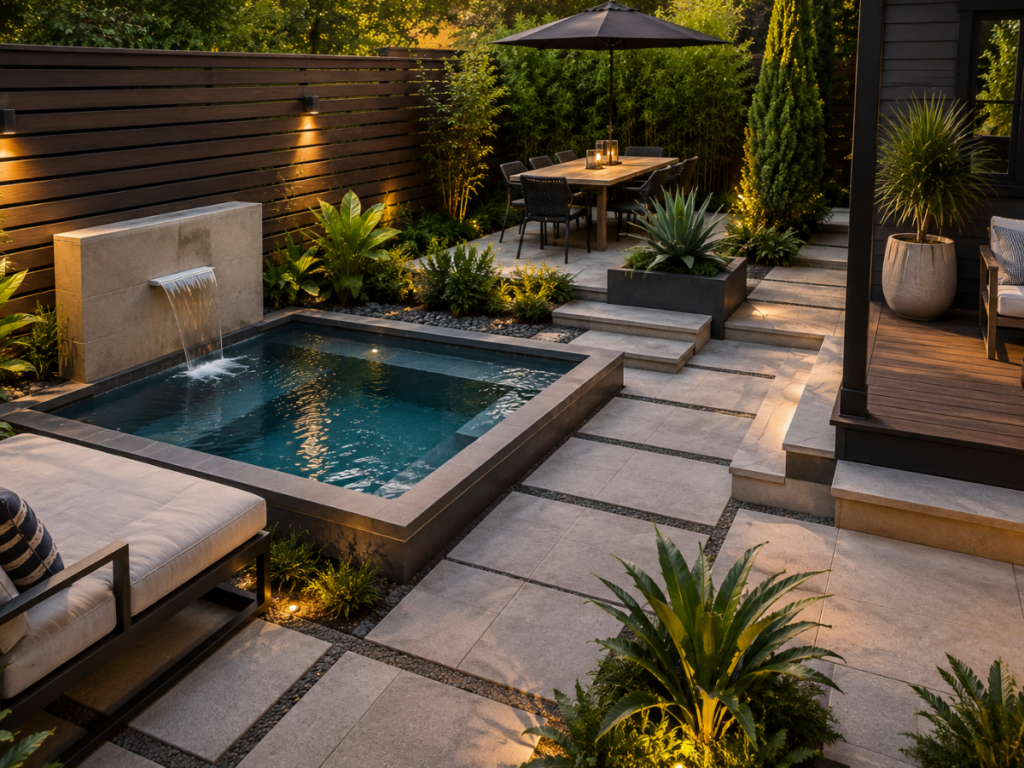
The most interesting plunge pool trends are less about making a small pool imitate a full-size one and more about designing the entire backyard around a compact footprint.
Homeowners are using plunge pools as architectural features, relaxation spaces, and extensions of patios rather than treating them as standalone additions.
For anyone researching plunge pool ideas, that shift opens up more possibilities. A smaller water feature can leave room for seating, landscaping, shade, and entertaining areas while still giving the backyard a strong focal point.
Integrated Pool and Patio Designs Make Small Yards Feel Larger
One of the strongest design directions is creating a continuous relationship between the plunge pool and the surrounding hardscape. Instead of placing a pool in the middle of the yard and filling the remaining space afterward, the pool becomes part of the patio layout from the beginning.
A rectangular plunge pool positioned along the edge of a patio, for example, can preserve an open area for dining or lounge furniture. Matching or complementary coping and paving can visually connect the pool to the rest of the space.
Built-in benches, wide entry steps, raised pool walls that double as casual seating, and compact tanning ledges can also make a small footprint work harder. The goal is not to fit as many features as possible into the pool. It is to make every square foot contribute to how the backyard will actually be used.
Natural Materials Are Softening Modern Pool Designs
Clean-lined rectangular pools remain a natural fit for compact yards, but they do not have to look stark. Current plunge pool ideas often combine simple geometry with materials and landscaping that soften the overall design.
Stone coping, textured pavers, wood-look surfaces, ornamental grasses, layered planting, and warm-toned finishes can help a modern pool settle naturally into its surroundings.
This approach works particularly well when the architecture of the home is contemporary, but the homeowner wants the backyard to feel relaxed rather than overly polished.
Another option is to use the landscape itself to frame the pool. Planting beds, privacy hedges, container gardens, or a small retaining wall can make the pool feel established within the yard instead of added as an afterthought.
Darker Pool Finishes Create a More Dramatic Look
Light blue is no longer the only visual direction for backyard pools. Dark gray, charcoal, deep blue, and other muted interior finishes can give compact pools a more reflective, sophisticated appearance.
The surrounding materials matter just as much as the pool finish. Dark water paired with pale stone can create contrast, while earthy coping and dense greenery can produce a quieter, garden-inspired setting.
Color should be evaluated in the actual outdoor environment whenever possible. Sun exposure, shade, surrounding surfaces, and water depth can all influence how an interior finish appears once the pool is filled.
Smart Pool Features Put More Control on Your Phone
Technology is becoming increasingly useful in small pool design, particularly when it reduces routine tasks rather than simply adding gadgets.
Depending on the equipment selected, connected pool controls may allow homeowners to manage filtration schedules, lighting, heating, pumps, or other compatible equipment through an app.
Automated sanitizing and cleaning equipment can also simplify routine pool care, although the available functions depend on the specific system.
Energy-efficient variable-speed pumps and thoughtfully selected heating equipment are worth considering during the design phase as well. Equipment should be chosen around the pool’s volume, desired temperature, expected use, and local conditions rather than added solely because it is marketed as “smart.”
Lighting Is Becoming Part of the Design, Not an Afterthought
Good lighting can completely change how a plunge pool feels after sunset. Instead of relying only on a bright underwater fixture, homeowners can layer several types of light throughout the backyard.
Underwater LEDs can illuminate the pool itself, while subtle step, pathway, landscape, or patio lighting helps define the surrounding space. The result is generally more inviting and useful than flooding the entire backyard with a single source of bright light.
Lighting placement should be planned alongside landscaping and hardscaping so fixtures, wiring, and controls can be incorporated cleanly into the finished design.
Privacy Features Are Becoming Part of the Pool Plan
A compact pool often sits closer to the home, property line, or neighboring yards than a traditional pool. That makes privacy an important design consideration.
Slatted screens, pergolas, privacy walls, strategic planting, and layered landscaping can create a more secluded setting without making a small backyard feel enclosed.
Some features can serve more than one purpose. A pergola may provide shade and architectural definition, while a planted screen can soften views and add greenery.
The most successful plunge pool ideas bring these elements together rather than chasing individual trends. A thoughtfully positioned pool, comfortable seating, useful technology, intentional lighting, and landscaping suited to the property can make a compact backyard feel complete without overcrowding it.
Where to Find Trusted Plunge Pool Contractors in Atlanta
A plunge pool may have a smaller footprint than a traditional swimming pool, but the installation still requires careful planning, excavation, plumbing, electrical work, structural construction, drainage, and code compliance.
The contractor you choose can influence everything from how well the pool fits the property to how smoothly the project moves through construction.
When comparing Atlanta contractors, look beyond attractive portfolios and starting prices. The goal is to find a company with the experience to turn your plunge pool ideas into a design that works with your property, budget, and long-term plans for the backyard.
Look for Experience With Compact Pool Projects
General pool-building experience is valuable, but small backyard projects present their own design challenges. Limited access, tight setbacks, existing patios, mature landscaping, slopes, retaining walls, and nearby structures can all affect what is practical.
Ask prospective contractors to show examples of pools completed on properties similar to yours. Pay attention to how they handled the entire backyard, not just the pool itself.
A strong compact-pool design should leave enough room for safe circulation, seating, landscaping, equipment access, and any other features you want to preserve.
This is particularly important if your plunge pool ideas involve fitting the pool into an unusually narrow or awkward section of the yard.
Compare the Scope of Each Pool Estimate
Three contractors can quote the same project and arrive at very different prices because they are not necessarily including the same work.
Request an itemized proposal that clearly identifies what is included.
At minimum, you should understand who is responsible for site preparation, excavation, soil removal, the pool structure or shell, plumbing, electrical work, equipment, interior finishes, coping, decking, permits, inspections, drainage, safety features, cleanup, and landscape restoration.
Also ask what is specifically excluded. Comparing total project scope instead of the bottom-line number makes it easier to spot allowances, optional upgrades, or unfinished work that could increase your final cost.
Verify Licensing, Insurance, and Permit Responsibilities
Before signing a contract, confirm that the company meets applicable state and local requirements for the work it will perform. Ask for current proof of insurance and find out whether specialized electrical, plumbing, or other work will be completed by appropriately qualified professionals.
Permit responsibility should also be established before construction begins. Ask who will prepare and submit applications, coordinate required inspections, and address corrections if an inspector identifies a problem.
Avoid assuming permits are included simply because the contractor regularly builds pools.
Ask Better Questions During the Consultation
A good consultation should involve more than choosing a pool shape and finish. The contractor should be evaluating how the proposed pool interacts with the property.
Useful questions include:
- Have you completed plunge pools on lots similar to mine?
- What site conditions could affect the design or price?
- How will equipment access and placement be handled?
- What drainage work may be necessary around the pool?
- Which parts of the project are completed by subcontractors?
- What could cause the price or schedule to change?
- What warranties apply to the pool structure, equipment, and workmanship?
- Who will be my primary contact once construction starts?
The quality of the answers can tell you a great deal about how thoroughly the company plans its projects.
Review Completed Projects and Speak With Past Clients
Online reviews are useful for identifying patterns, but they should not be the only basis for your decision. Ask to see recent completed projects and, when possible, request references from homeowners whose projects were similar in size or scope.
Questions about communication can be just as revealing as questions about workmanship. Did the contractor explain changes before proceeding? Were unexpected costs documented? Was the jobsite managed responsibly? Were problems addressed after installation?
A beautiful finished photograph does not show what the construction experience was like.
Watch for Warning Signs Before Signing
Be cautious when a contractor provides a vague estimate, pressures you to sign quickly, cannot explain permitting responsibilities, or is unwilling to document important promises in writing.
Large unexplained upfront payments or estimates that are dramatically lower than comparable proposals also deserve closer examination.
The contract should clearly describe the scope of work, payment schedule, major materials and equipment, warranties, change-order process, and other important project terms.
Choose a Contractor Who Understands the Whole Backyard
The best contractor is not necessarily the company offering the largest pool or lowest quote. For a compact backyard, thoughtful design can be more valuable than sheer size.
Bring your preferred plunge pool ideas to consultations, but pay attention to contractors who ask how you want to use the space around the water as well.
A well-planned project should consider the pool, decking, circulation, privacy, landscaping, drainage, equipment, and outdoor living areas as parts of one backyard rather than separate decisions.
Conclusion
A small backyard does not have to stand in the way of creating a relaxing and functional outdoor retreat. With thoughtful placement, space-saving features, and a plunge pool design tailored to your property, even a compact Atlanta yard can provide the perfect place to cool off, unwind, and entertain.
Working with experienced pool professionals can help you make the most of the available space while creating a design that complements your home and lifestyle.
For custom pool design and expert installation, choose Clear Water Pools Atlanta. If you’re ready to explore what a plunge pool could look like in your backyard, call 770-406-8638 to speak with the team at Clear Water Pools Atlanta or request your pool estimate today.